
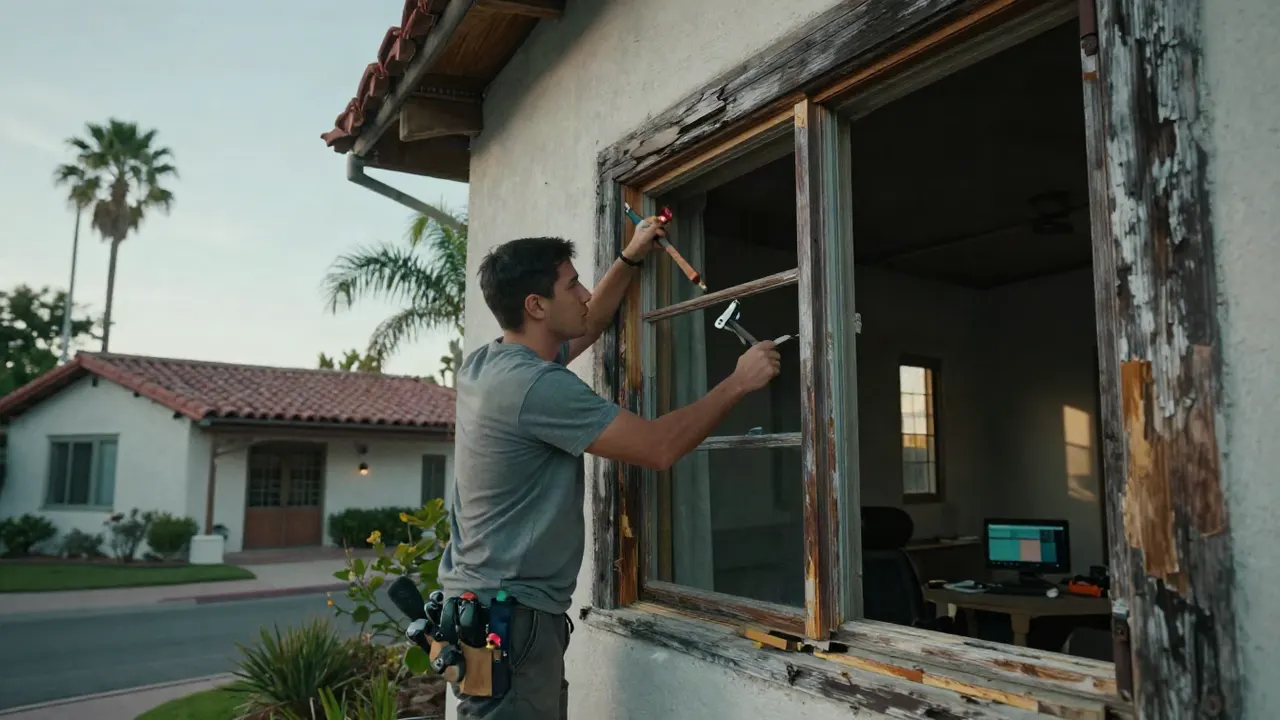
Window frames rot because water gets in and cannot get out. That is the whole mechanism - rain, irrigation spray, or condensation soaks into the wood or collects in the frame channel, the seal that should shed it has failed, and the wood stays wet long enough for fungi to break down the fibers. In Los Angeles, the process is slower than in Seattle but sneakier, because our dry summers hide the damage until a winter storm finds it.
Below we walk through the specific causes we see on service calls across the San Fernando Valley and greater LA, how to spot rot before it spreads into the wall, what repair costs in 2026, and the maintenance routine that actually keeps frames dry.
What Actually Causes Window Frames to Rot in Los Angeles
What causes window frames to rot Los Angeles homeowners ask us about most often comes down to five failure points, and almost every rotted frame we pull traces back to one of them.
1. Failed paint and caulk joints
Paint is not decoration on a wood window - it is the waterproof membrane. Once it cracks, chalks, or peels along the sill or the bottom rail, water wicks straight into the end grain. End grain absorbs moisture 10 to 20 times faster than the face of the board. A hairline crack you can barely see in July becomes a soft sill by January.
2. Clogged weep holes and blocked sill pans
Every properly built window has a drainage path - weep holes at the bottom of the frame, a sloped sill, and often a metal pan under the unit. When those weep holes clog with dirt, pollen, or paint, water sits in the channel instead of draining out. Standing water against a wood sill is the single fastest route to rot we see.
3. Condensation and interior moisture
Los Angeles homes run humidifiers in winter, dryers and bathroom fans that vent poorly, and swamp coolers in older Valley houses. When warm interior air hits a cold single-pane window, it condenses on the glass and runs down into the frame. Over a season, that repeated wet-dry cycle softens the bottom rail from the inside out.
4. Termites and wood-boring insects
Damp wood attracts subterranean termites, and Los Angeles County has plenty of them. Termites do not cause rot, but they exploit it - once the wood is soft, they tunnel through and hollow the frame. By the time you see frass or mud tubes, the frame is usually past saving.
5. Roof and stucco leaks above the window
Sometimes the rot is not the window's fault at all. A failed flashing detail, a cracked stucco joint, or a roof leak above the header lets water run down inside the wall cavity and pool at the window rough opening. We have pulled frames in Sherman Oaks Window Replacement Contractor territory where the window itself was fine but the flashing above it had been leaking for years.
Why Los Angeles Homes Rot Differently Than the Rest of the Country
Window frame deterioration Los Angeles CA properties experience follows a different timeline than homes in the Midwest or Pacific Northwest. Our climate is dry for eight months and then dumps a season's worth of rain in a few weeks. That pattern creates two specific problems.
First, UV. Los Angeles gets roughly 280 sunny days a year, and the UV index regularly hits 8 to 10 in summer. That intensity bakes the paint and caulk on south- and west-facing windows, breaking the seal long before the wood itself shows wear. A window that faces west in Woodland Hills will need repainting two to three times as often as the same window on the north side of the house.
Second, the marine layer and winter storms. Coastal and Valley homes swing between 20% and 90% relative humidity across the year. Wood expands and contracts with every swing, opening the joints where water gets in. Then the atmospheric river storms we get in December through March drive water sideways into those open joints for days at a time.
Older housing stock makes it worse. A large share of homes in North Hollywood Window Replacement Contractor neighborhoods were built between 1920 and 1960 with wood double-hung windows that have never been fully re-glazed. Those frames are 60 to 100 years old, and most have been repainted over failing caulk rather than repaired properly.
Signs of Window Frame Rot Los Angeles Homeowners Miss
The early signs of window frame rot Los Angeles homeowners overlook are almost always tactile, not visual. Rot starts inside the wood, so the surface can look fine while the core is already soft.
- Soft spots when you press. Push a screwdriver into the sill and lower corners. If it sinks in like wet cardboard, you have rot.
- Paint that bubbles or flakes in patches. Bubbling paint means moisture is pushing out from behind it.
- Windows that stick or will not close flush. Swollen wood is a classic first symptom.
- A musty smell near the window. That is fungal activity you cannot see yet.
- Crumbling or powdery wood at the sill. Dry rot leaves a brown, powdery residue.
- Visible water stains on the interior trim or drywall below the window. The rot has already reached the wall.
If you catch it at the soft-spot stage, you are usually looking at a repair. If you catch it at the water-stain stage, you are often looking at a Full Frame Window Replacement Los Angeles CA because the rough opening itself has been compromised.
How Do I Know If My Window Frames Are Rotting in Los Angeles CA?
You know your window frames are rotting in Los Angeles when a probe test with a screwdriver or awl sinks more than a quarter inch into the sill, lower rail, or corner joints without resistance. That is the definitive field test - no moisture meter required.
Do it in three places: the center of the sill, both bottom corners of the frame, and the bottom of the sash itself. If two or more spots are soft, the frame is compromised. If only one small spot is soft, you may still be able to cut out and replace that section.
A moisture meter helps confirm it. Readings above 20% on a wood frame mean active moisture intrusion. Above 28%, fungal decay is almost certainly underway. We carry both tools on every service call.
Window Frame Rot Repair Cost Los Angeles: What to Expect in 2026
Window frame rot repair cost Los Angeles homeowners pay in 2026 runs from about $350 for a small epoxy-and-patch job on one sill to $1,800 or more per window when the sash, sill, and surrounding trim all need replacing.
Here is how the pricing actually breaks down:
- Minor sill repair (epoxy filler, sand, prime, paint): $350-$650 per window.
- Partial frame rebuild (new sill plus lower rail): $700-$1,200 per window.
- Full sash and frame replacement: $900-$1,800 per window.
- Full-frame window replacement when the rough opening is damaged: $1,400-$3,200 per window installed, depending on size and material.
- Hidden damage discovered after opening the wall (sheathing, framing, insulation): add $400-$1,500 per window.
Two things drive the spread. First, how much of the frame is soft - surface rot is cheap, structural rot is not. Second, whether the rot has reached the wall. If we open the frame and find black sheathing or soft framing, the scope changes fast.
For homeowners with multiple rotted windows, replacement usually beats repair on a per-window basis. Once you are past three or four rotted units, a Retrofit Window Replacement Los Angeles CA that keeps the existing trim and interior finish is often the more economical path, and it eliminates the moisture problem permanently instead of patching it.
How to Prevent Window Frame Rot in Los Angeles
Window frame rot prevention Los Angeles homeowners can actually keep up with comes down to a short seasonal checklist. The goal is simple: keep water moving away from the wood and keep the paint and caulk intact.
- Inspect and re-caulk every fall, before the rains. October and November are the right months here. Check the exterior perimeter of every window, especially the top and bottom edges.
- Repaint exterior wood every 4 to 6 years on sun-facing windows. West- and south-facing windows may need it every 3 to 4 years.
- Clear weep holes twice a year. A toothpick or a can of compressed air does it. Do this in spring and again in October.
- Keep sprinklers off the siding. Adjust heads so they do not spray the wall below windows. This is one of the most common causes we find in Valley neighborhoods.
- Fix roof and stucco leaks immediately. A $200 flashing repair now prevents a $4,000 window and wall repair later.
- Run bathroom and kitchen exhaust fans. Ten to fifteen minutes after every shower or cooking session keeps interior humidity down and reduces condensation on the glass.
If you are already seeing soft wood, the smart move is a professional inspection before the next rainy season. Our team handles Window Sash Replacement Los Angeles CA for frames where the sill is sound but the sash has rotted, which is a much smaller job than a full replacement.
Common Mistakes That Speed Up Window Frame Deterioration
We see the same handful of mistakes over and over on service calls, and each one turns a $400 repair into a $2,000 replacement.
- Caulking over wet or rotted wood. You trap the moisture in and it spreads. Always cut out the rot first.
- Using the wrong caulk. Painter's caulk fails in two years on exterior LA windows. You want a 100% silicone or a high-performance polyurethane sealant rated for exterior use.
- Painting over a failing joint instead of repairing it. Paint hides the problem for one season and guarantees a bigger one the next.
- Pressure-washing window frames. It drives water into every joint and strips the paint that is protecting the wood.
- Ignoring a single soft spot. Rot spreads along the grain. A quarter-sized soft spot becomes a rotted sill in one rainy season.
- Letting sprinklers hit the siding year-round. Constant moisture on the wall below a window is a rot factory.
When to Call a Professional
Call us when the rot has moved past the surface - when the wood is soft more than a quarter inch deep, when you see water stains on the interior trim or drywall, when windows will not open or close, or when you find termite damage alongside the rot. Those are the situations where a patch job fails and a proper repair or replacement is the only fix that holds.
At American Reliable Windows & Doors, we inspect the frame, the flashing, and the rough opening, then tell you plainly whether repair or replacement makes more sense for that window. No pressure either way - we would rather fix one window correctly than replace five you did not need.
If you are not sure which side of that line you are on, we will come out and probe the frames with you.
Frequently Asked Questions
What causes window frames to rot in Los Angeles?
Trapped moisture from failed caulk, clogged weep holes, condensation, and roof or stucco leaks above the window. LA's UV breaks down exterior seals faster than most climates, and winter storms then drive water into the open joints.
How do I know if my window frames are rotting in Los Angeles CA?
Probe the sill and lower corners with a screwdriver. If it sinks more than a quarter inch without resistance, you have rot. A moisture meter reading above 20% confirms active intrusion. Bubbling paint and sticking windows are earlier warnings.
Can I repair rotted window frames in Los Angeles?
Yes, if the rot is shallow and localized. Epoxy filler and partial sill replacement run $350-$1,200 per window. If the rot has reached the rough opening or the wall, full-frame replacement is the only permanent fix.
How to prevent window frame rot in Los Angeles?
Re-caulk every October before the rains, repaint sun-facing frames every 3-6 years, clear weep holes twice a year, keep sprinklers off the siding, and fix roof or stucco leaks immediately. That routine prevents most rot we see.
Does homeowners insurance cover window frame rot in Los Angeles?
Usually not. Insurance covers sudden damage like a storm-driven leak, but rot is classified as gradual deterioration and is excluded from most policies. Repair or replacement is typically out of pocket.
Get Help with Window Replacement Contractor in Los Angeles
If you have soft wood, bubbling paint, or windows that will not close, we can tell you in one visit whether it is a repair or a replacement. American Reliable Windows & Doors serves homeowners across Los Angeles and the San Fernando Valley.
Call +1 (747) 298-4287 to schedule an inspection. We will probe the frames, check the flashing, and give you a straight answer on what the fix actually costs.